
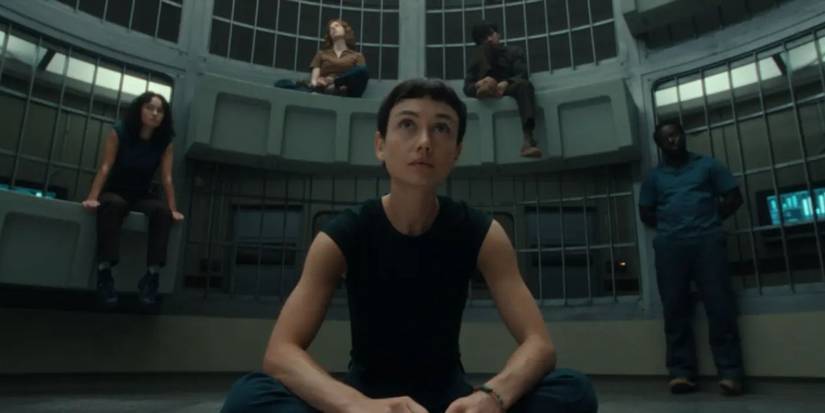
Season 1 of ALIEN: EARTH, which I was loving (and still mostly do) ended on what I would call a terrible decision. That terrible decision was the terrible decision that showrunners keep making because they saw STAR TREK: THE NEXT GENERATION one time.
I was going to go on another rant about cliffhangers, but I realized I had a perfectly good one raring to go from a blog I posted like ten years ago when I got mad about the infamous Walking Dead cliffhanger.
The nice thing is, all the lessons are still evergreen, so I’ve done a fresh draft on those ideas. I’ve also added a new section about forgiving cliffhangers based on time and production schedules, which is more relevant in the “8 episodes every three years” streaming era.
Alright, let’s dive into it. But first we start with a simple question, before we can get going:
Why Use a Cliffhanger?
Traditionally, a cliffhanger is used to keep interest going after a story or scene has (or would have) ended. I’m an author by trade, and I can tell you that we’re encouraged to end every chapter on a cliffhanger. Introduce a new threat, change an allegiance, slap in a new complication, someone’s head falls off unexpectedly, etc.
Now, like any writing tool, it has its function, and a most appropriate time and place for its use. I don’t recommend ending EVERY chapter that way, no more than I would recommend ending every story with a boss fight. Sometimes the best way to introduce excitement for the next chapter is to make sure that THIS chapter tells a great story. Sometimes (editors, cover your ears), a satisfying conclusion makes an audience think to themselves: “Wait a minute, isn’t the story over? How is there a next chapter?”
BUFFY THE VAMPIRE SLAYER season one ended with all of the story lines wrapped up and the Big Bad Evil Guy dead as fried chicken. I remember thinking: “Wait, what is season two going to be about? Where the hell do they possibly have to go?” That didn’t turn me away as a audience member. That DREW ME IN. Because the first season told a complete and satisfying story, I used my built in cause-and-effect brain equipment to go “hey, do you think they’ll tell another complete and satisfying story in season two? Oh shiiiiit.”
And I watched it. And they did.
What is a Cliffhanger?
Okay, well, yes. But not that one.
Here’s where language fails us, and I have to go off-book. My personal definition of a cliffhanger is “an incomplete story designed to manipulate the audience.” I’ve always held that belief, and I always will.
I would make a distinction, though, between a “sequel hook” and a “cliffhanger.” To me, ending a discrete unit of storytelling on a cliffhanger is dirty pool. Ending it on a sequel hook, on the other hand, is a must in serialized storytelling. A sequel hook gives us a new twist or piece of conflict that HAS NOTHING TO DO with the arc that was set up the entire story. It opens a new road, it doesn’t drop a gate across the road we’re already on.
The folks who defend cliffhangers like the one in ALIEN: EARTH insist that these season finales are no different than the ends of other beloved works. They’ve made comparisons to EMPIRE STRIKES BACK and the famous “Fire” cliffhanger from STAR TREK: THE NEXT GENERATION’s seminal Borg two-parter, “Best of Both Worlds Part 1.”
All I gotta say to that is: nope. Nope on rocket skates.
Your Examples Are Bad and You Should Feel Bad
Let’s start with the EMPIRE STRIKES BACK comparison. First and most fore: EMPIRE STRIKES BACK doesn’t end on a cliffhanger. It ends on a sequel hook. How can you tell? It’s easy, you just have to look at the story.
A complete story is a question, and an answer. That’s it. Here are the questions asked in the beginning/middle of EMPIRE STRIKES BACK, and the answers that the movie gives us by the end.
Will Han, Leia, and Chewie escape the Empire after the disastrous Battle of Hoth? (No)
Will Luke Skywalker complete his training as a Jedi? (No)
Will Han and Leia fall in love? (Yes)
Will Yoda and Obi-Wan be able to tame Luke’s more Anakin-like impulses? (No)
Will Vader be able to capture Luke Skywalker and bring him to his Emperor? (No)
Will Luke be able to face and defeat Vader? (Yes / No)
Is Lando really a dickhead? (No)
That’s it. Those are the questions that are set up and answered. EMPIRE STRIKES BACK is a complete story, contrary to popular opinion. Are there twists and sequel hooks? Absolutely. But you can tell they’re sequel hooks and not cliffhangers because they present new questions that the movie didn’t ask before. Here are the questions introduced at the end of EMPIRE STRIKES BACK:
Is Vader really Luke’s father?
Can Han be rescued from Boba Fett / Jabba the Hutt?
Neither of those questions were asked in the beginning/middle of the story and simply not paid off.
If EMPIRE STRIKES BACK was the season 1 finale of ALIEN: EARTH, on the other hand, it would have gone a little differently.
EMPIRE STRIKES BACK, Bad Cliffhanger Style
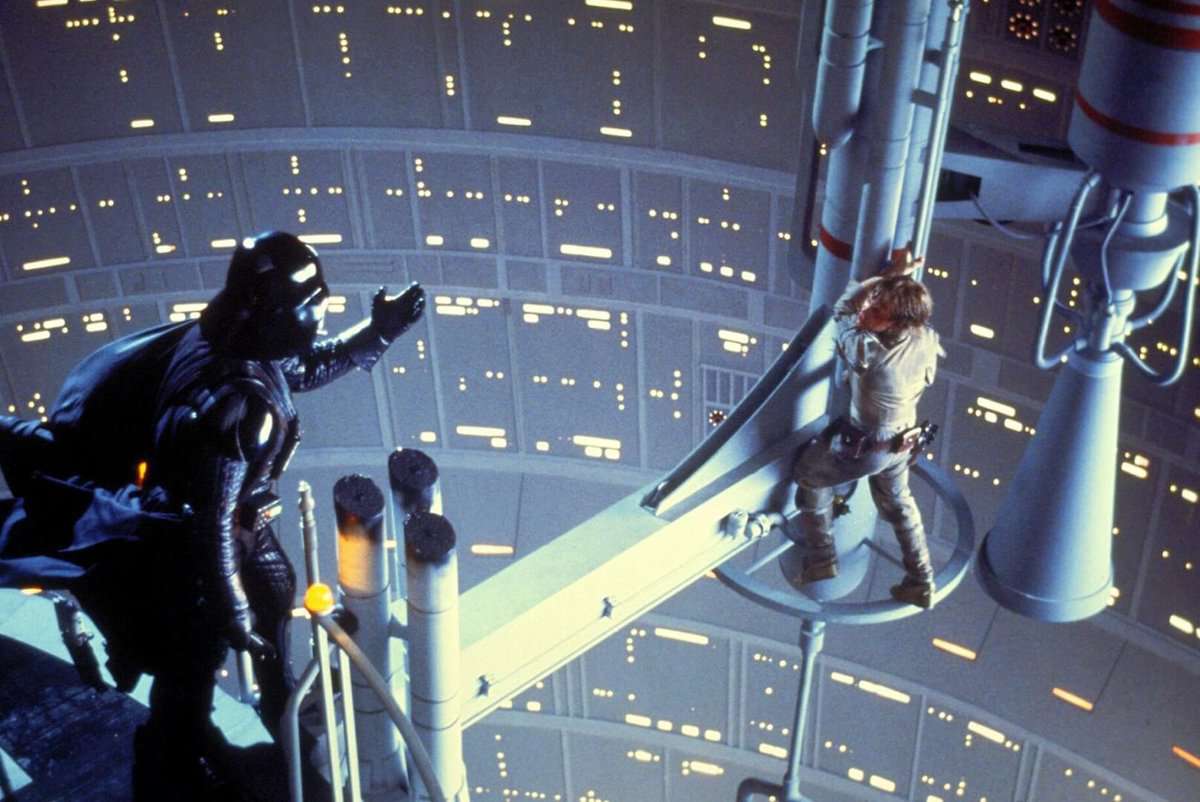
To continue the comparison, that would be like if EMPIRE STRIKES BACK had a scene early on where Luke is sitting alone and says, “I wish I knew more about my father.” Then, later on, an Imperial officer is talking to Vader, and Vader goes “I know who Luke’s father is. And that shit is going to be surprising.” And then, during their climactic duel, Vader leans in and says, “Luke. Your father is not who you think he is. Your father is really . . . “ and then the sound cuts out, and we focus on Luke’s face. Then Luke bellows “NOOOOOOOO” and we cut to credits.
You can say, “Oh, well, the story is actually about whether or not Luke is happy with who his father is,” and then you could say, “Look, Luke is pissed, which means it’s bad. That’s a story.” You can say that, but you’d be wrong.
If that had happened, the movie would have asked a question, foreshadowed an answer, and then not finished the goddamn story. That would be a “cliffhanger,” which is manipulative and cheap. Would people have still gone to see RETURN OF THE JEDI? Sure. Would they be majestically pissed that they gave their time and money to see a movie and didn’t get a complete story? Bet your ass.
Would “Empire” be the beloved film classic it is today? Take a guess.
The Linear Time Problem
I will say this, in light defense of cliffhangers: time is a factor.
Think of my earlier example about book chapters: no one is particularly upset when a book chapter ends in a cliffhanger. Why? Because they can turn the page and keep reading. In fact, that’s literally the purpose of chapter-ending cliffhangers. The end of a chapter is a natural putting-down point for a novel: maybe you’ve been reading a bit, you’re tired, and you get a nice dopamine hit from finishing a chapter. So you can take a break. Ending a chapter on a cliffhanger is a light antidote to that cooling effect; it keeps the reader reading.
It’s a tactic that contributes to a “breakneck pace.”
Season-ending cliffhangers in the streaming era are universally a mistake because you can’t turn the page. Instead, you have to wait two-to-three years for the next season, which viewers know by now may never come. Too many streaming services have shown their hand: if a streaming show isn’t a runaway success it’s getting cut. The energy you put into season one may end up feeling like a massive waste of juice.
“But how did they do it in the broadcast days?! What about Best of Both Worlds, everyone loves that cliffhanger!” Well, no they all didn’t. I was alive at the time and a watcher of the show and I remember distinctly not everyone was excited to wait an entire summer to see if Jean-Luc Picard would be torpedoed into space dust.
But, even those who did enjoy it only had to wait three months. That’s it. And they knew STAR TREK: THE NEXT GENERATION was coming back with an entire season of 26 episodes in three months. There is no such guarantee in modern streaming.
Ergo, vis a vis, don’t do fucking season-ending cliffhangers in modern TV. You’re practically begging the audience to sigh and delete your show from their list.

I myself ended book four of my Deadgirl series on a cliffhanger, despite all this shit I just wrote about cliffhangers. However, I had the fifth and final book nearly finished and it came out only seven months later by design. And honestly I still feel a little bad about it.
In Concussion
ALIEN: EARTH is a good show with fantastic actors and solid storytelling: it didn’t need a cliffhanger to keep people interested. Closing one or two of the season’s promised storylines would have shown the audience that the show can be counted on to conclude a tale in a satisfying way.
And it’s fundamentally a misunderstanding of what television IS (another common problem in the prestige streaming era). A show isn’t just a ten hour movie hacked into pieces. TV is an art form, and being able to mix serialized and episodic content in the same show is fundamental to that art. And, ideally, closing the season’s arc at the end while leaving room for the show’s arc to continue.
A season finale is a show’s chance to communicate that it understands the assignment. And ALIEN: EARTH, despite everything else it did right, simply didn’t.


 B.C. Johnson
I love your analysis. Going to link to this post in my next monthly recap (which doesn’t come out until, well, next month, but 🤷♀️ 😅).
Also, I only just noticed the tag “cliffhangers are bad and dumb” LOL.
Thank you!