This is B.C. Johnson, your RSI-neurojacked author, and today we’re sitting down with Adam Bassett, author of DIGITAL EXTREMITIES.
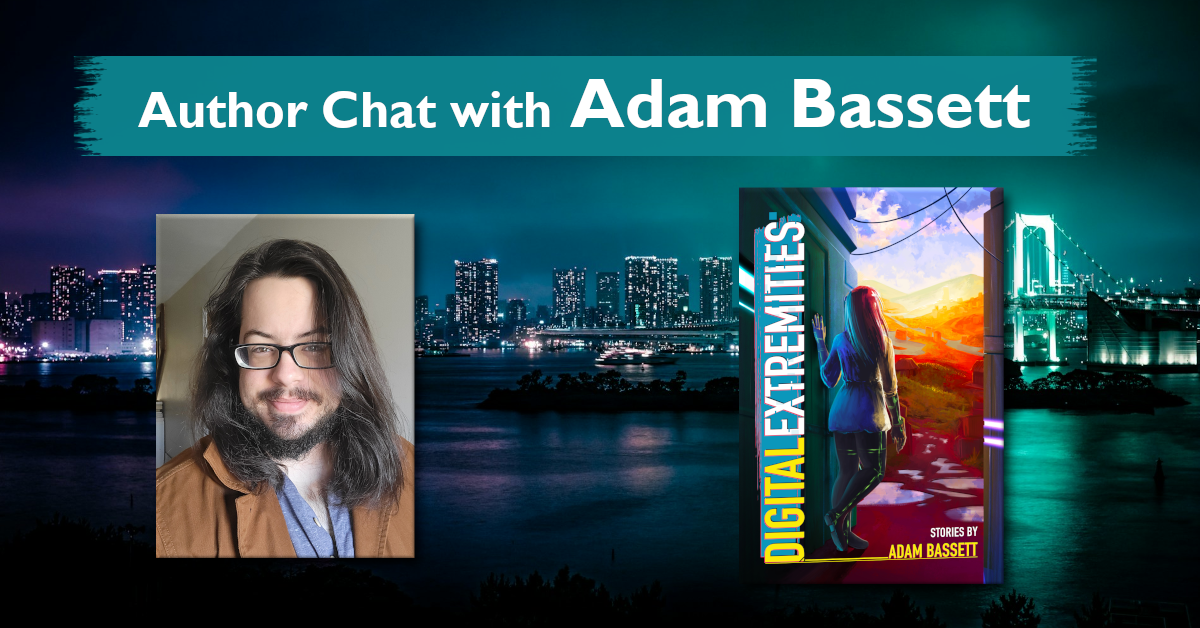
About the Author
My name’s Adam, and I’m a UX/UI designer for Campfire, where I help make writing software and a reading app. I also occasionally create maps for other authors, when I’ve got time. A few have been published, such as those in Robyn Dabney’s novel THE ASCEDITURE.
Although, the reason I’m here today is because in addition to all that (somehow) I am also the author of DIGITAL EXTREMITIES and ANIMUS PARADOX.
DE is a short story collection that focuses on rural and remote places in an increasingly cyberpunk setting, focused on regular people’s lives as they navigate grief, debt, and other personal issues. AP is a short novel and direct sequel to one of those stories, though the connection is fairly loose. Where the stories are a bit more introspective, AP is more bombastic and action-heavy.
The Questions
1. Do you have a writer you idolize?
I’m a massive fan of Brian McClellan’s work. His blend of industrial-age tech and magic is always a ton of fun.
T.R. Napper is up there as well, his work is thought-provoking and badass all at once, I’m excited to dig into some of his new work soon—my TBR is out of hand so I was tackling a few things on the list before picking up some books he recently published.
(Editor’s Note: I love Brian McClellan’s “Powder Mage” trilogy! Hard recommendation for fantasy fans.)
2. What are you reading right now, and how is it?
At time of writing I’m reading COUNTESS by Suzan Palumbo, a sci-fi novella that’s heavily inspired by THE COUNT OF MONTE CRISTO. The first chapter is a bit of a hurdle as you learn the in-world terminology and history, but once you get over the hump it’s stunning. I expect to finish it in the next day or two.
3. I love a book with a map in it. What do you think a map adds to a story?
That depends on the story and map in question. In “A Song of Ice and Fire,” Martin’s maps are a kind of reference tool for the reader to flip to and see the distance between different locations, and—in combination with the appendix—regional alliances. In MISTBORN, the map is less of a map and more a monument to the setting. It points out some key locations, but mostly serves to feel like it exists within the setting through the unique design and in-world symbology.
The map in THE GIRL WHO COULD MOVE SHIT WITH HER MIND is another example of that, but through a contemporary lens, and rather than make us feel the depth of the world it instead focuses on the main character. The map is annotated with comments and labels “created by” Tegan Frost, and they give us a good idea about the things that she cares about.
I could go on, but I think you get the point. There are lots of different kinds of maps and stories. The important thing is that you pick the type of approach which best serves your story.
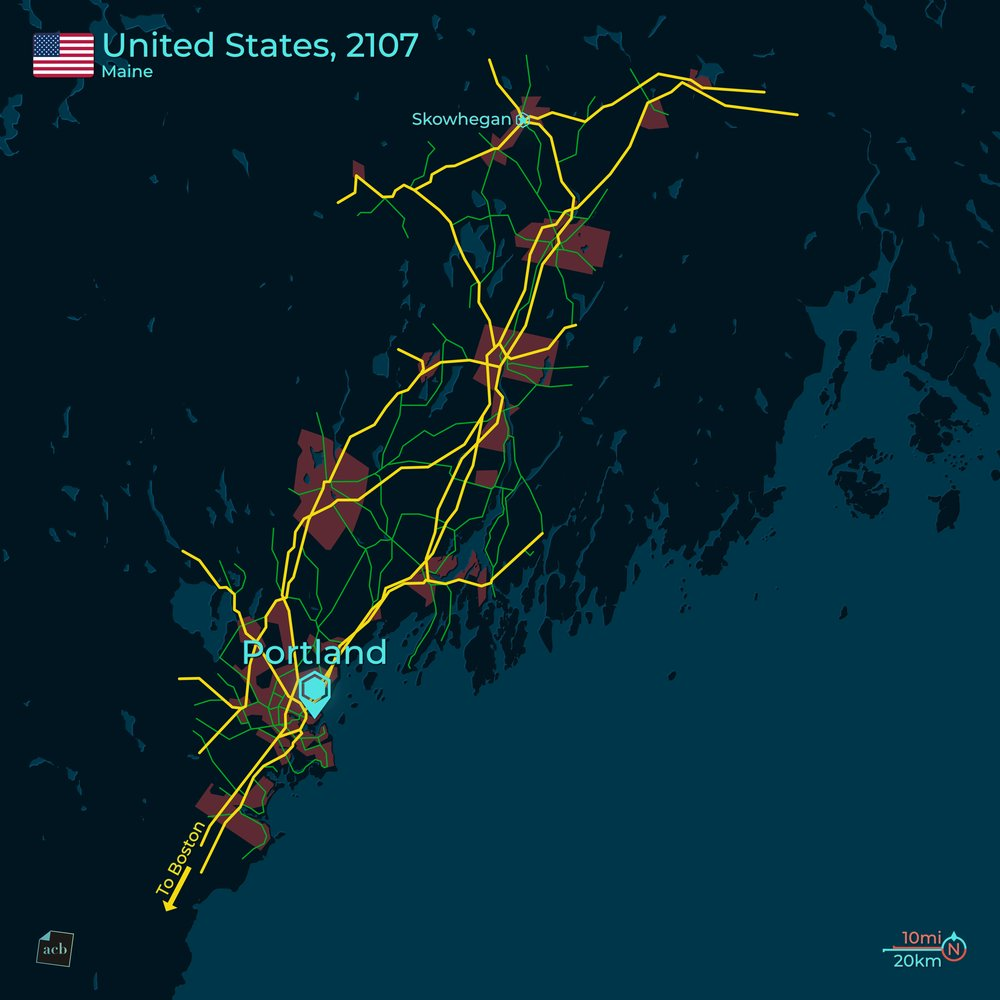
Portland, 2107 map by Adam Bassett
4. What got you into cyberpunk, and how do you feel about its evolution since the William Gibson days?
I first got into cyberpunk by reading NEUROMANCER, but I think I fell in love with the genre because of T.R. Napper’s NEON LEVIATHAN. I enjoyed Neuromancer, don’t get me wrong, but it’s a little tough to read, and I never felt too connected with Case or Molly. Reading Napper’s work felt like the first time I read cyberpunk that put the characters first, rather than the plot. The format of a short story collection also allows you to explore more of the setting across different locations, perspectives, and times—and I eat that up.
Talking about how the genre has changed since Gibson’s original work isn’t something we have time for here. You’ve just asked about 40 years of history about a relatively new genre that—frankly—I think people are still trying to figure out. Cyberpunk is a lot of things, but I think a lot of them boil down into uncertainty and anxiety: uncertainty about the future, and anxiety about our role in it. That used to be presented about fears regarding technology and Japan. Now I think that’s shifted to fears about the environment, A.I., and China.
What we imagined cyberpunk to be in the 80s is kind of already here with augmented reality and wearable tech, advanced computers, and so on. A.I. is on the way. So our perspective on all that has changed. I think modern cyberpunk is more about how those tools are used and the human element within them—namely how we retain our humanity when we’re so consumed by technology.
But you see how even in this brief discussion we’re pulled in so many different directions. That’s what I mean when I said we’re still figuring out what we want cyberpunk to be. It’s hard to pin down because it’s about that mix of humanity and technology and that can go in a lot of different directions.
5. What does your editing process look like? Has it changed over time?
I’m self-publishing my work right now for the most part, so there’s that voice in my head screaming about how I’m forgetting something or my work is low-quality. The best way to shut it up is to read it several times and bring on some trusted people to help edit. The ARC has been a good final pass as well. Everything should be fixed by then, but I always let people know to tell me if they notice something that looks off. I’d rather find out during the ARC period than after the book is released.
But, yeah, I’m just reading it over and over, and bringing in people to help where possible. So far it seems to be working alright.
6. Do you write with or without music?
With music, always, unless I’m at the local coffee shop or somewhere else I can’t. I’ve even made a few playlists for my recent books that feature a ton of electronic and synth tracks, though I don’t always listen to them while writing.
I like variety, so sometimes I end up on pop, rock, or something else. Lately I’ve been really into Marina Satti and Felix Cartal.
7. Who was the easiest character you’ve ever written for? Who was the hardest?
The easiest was probably the unnamed character from “Buying Time,” a story in DIGITAL EXTREMITIES. That story always felt a bit personal, for reasons I can’t fully articulate. Once I found his voice, I locked in and the rest just flowed.
The hardest might have been Jun’ichi, a point-of-view character from ANIMUS PARADOX. Writing from his perspective was never part of the plan, but things progressed in a way where doing so made a lot of sense. The main challenge came from the fact he didn’t really have a deep backstory at the time, so I had to figure that out to help inform his actions and thoughts. He also only speaks Japanese, so figuring out how to represent that on the page in an English-language novel was a challenge.
One early draft had all of his POV dialogue in romaji, but my editors pushed hard to change that to English since it was just too hard to follow along even with some strong context clues. Jun’ichi was a fun character to write, though. He had some of the best action scenes.
8. Has a character or plot twist you’ve written ever surprised you?
ANIMUS PARADOX was planned fairly meticulously, the only things that got added while drafting were pauses in the action, scenes of people getting food or recovering after a conflict.
The biggest surprise for me in writing DIGITAL EXTREMITIES probably came from “36 Broadway Avenue.” I knew how the story would begin and end for a while, but it didn’t quite sit right with me. The original ending simply had a character die, and that didn’t feel interesting enough—especially considering that was the ending of one other story in the collection as well. So I knew I needed to do something more with it.
I had an idea for the epilogue scene while visiting my parents for the holidays and walking their dog, then ran back and wrote it down. I’m very pleased with that story, and several readers have told me it’s one of their favorites from the collection, so I’m glad for that walk.
What Can Readers Check Out?
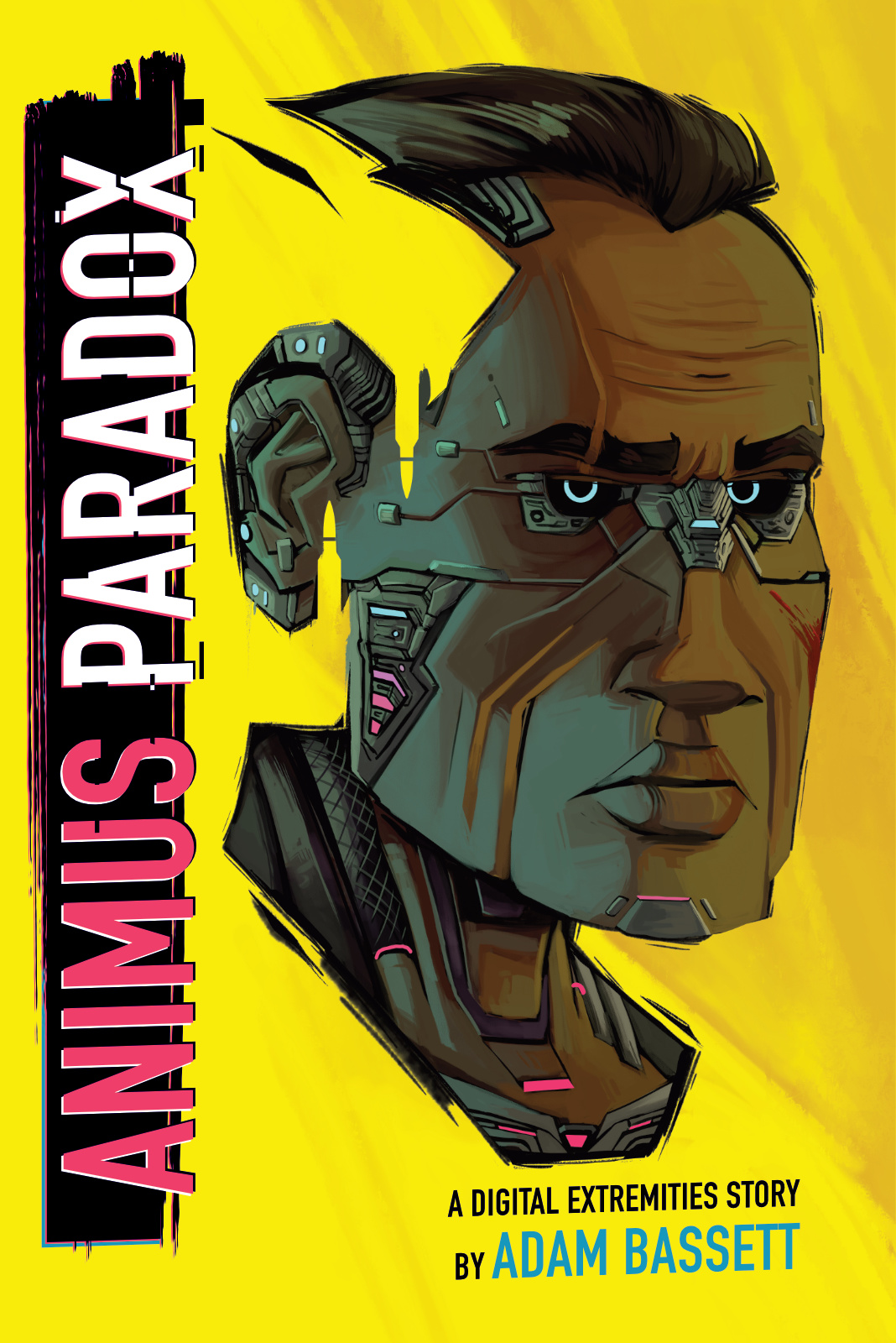
ANIMUS PARADOX comes out January 27th. DE is already out, and you can expect more stories in this setting at some point.
My next project, however, is a book about map design for sci-fi and fantasy authors. It’s going to include a ton of references, prompts, and advice from several authors and cartographers. Besides myself, about 20 people have in some way been involved with the project either providing quotes, examples, or offering suggestions about the books’ content.
It’ll have a bunch of great tips about map design, but also some things you can use in prose for actually writing your book or planning the details of the setting and cultures in it. I’m very excited about it, and hope to release it sometime in the summer of 2025.
Where to Find the Author
I’m @adamcbassett on Bluesky, Threads, and Instagram. You can also find me at adamcbassett.com and the newsletter linked there.
Thursday: Author Elizabeth M. Hurst
This is BC again, thanks for stopping by! We’ll be back Thursday with author Elizabeth M. Hurst.
You can subscribe to my blog to get updates as they arrive, or follow me on Threads or Bluesky where I’ll be posting them as well.


 B.C. Johnson
“I think modern cyberpunk is more about how those tools are used and the human element within them—namely how we retain our humanity when we’re so consumed by technology.“
Interesting insight in the genre! Also cool that Adam designs maps for novels and has a how-to book in the pipeline.
Boosting on Twitter and Bluesky!
Right? I love maps so much.
Thanks again!